Freehold vs Leasehold Condo in Singapore: Which One Is Right for You?
When buying a condo in Singapore, one decision will follow you for decades: choosing between freehold vs leasehold tenure. It quietly shapes your loan eligibility, your resale value, and your long-term wealth. This guide Explore the pros and cons of freehold vs leasehold condos in Singapore, and find out which tenure better suits your budget and long-term goals.
Table of Contents
1. What Do Freehold and Leasehold Mean?
2. How Big Is the Price Gap?
3. Lease Decay: Financing Implications Over Time
4. En Bloc Potential: A Variable to Consider
5. Rental Yield: Does Tenure Matter to Tenants?
6. Who Should Buy Freehold Property?
7. Who Should Buy Leasehold Property?
8. Practical Tips
What Do Freehold and Leasehold Actually Mean?
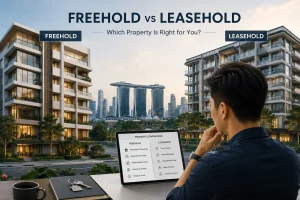
In Singapore’s condo market, freehold vs leasehold refers to how long you legally own your condo and the land sits on.
A freehold title means you own the property in perpetuity, there is no expiry date. The land and the unit are yours (and your heirs’) indefinitely, subject to government acquisition rights under the Land Acquisition Act.
A leasehold title, on the other hand, grants ownership for a fixed period, most commonly 99 years, though 999-year leasehold titles also exist. Once the lease runs out, the land reverts to the state. For practical purposes in this guide, “leasehold” refers to 99-year tenure.
Understanding this single distinction is the fundamental difference between freehold vs leasehold condo.
How Big Is the Price Gap?
This is the first question most buyers ask when weighing freehold vs leasehold options. Generally, freehold condos command a 20% to 30% premium over comparable leasehold developments in the same district, though this varies significantly by location, age, and developer.
However, the comparison gets more nuanced over time. A brand-new leasehold condo with strong amenities and an MRT right at its doorstep can outperform an older freehold condo in terms of rental yield and short-term capital appreciation. Location still dominates tenure in the short run.
The freehold vs leasehold price gap also widens when comparing older properties. A 40-year-old freehold condo retains much of its land value, while a 40-year-old 99-year leasehold condo has already “used up” a significant chunk of its lease and valuations reflect this.
Lease Decay: Financing Implications Over Time
One key distinction between freehold and leasehold properties relates to how remaining lease tenure affects buyer financing eligibility.
As a leasehold property ages, CPF withdrawal rules and bank lending policies become increasingly restrictive:
• CPF usage for property purchase is subject to restrictions based on remaining lease
• Banks may reduce Loan-to-Value (LTV) ratios as remaining lease shortens
• Properties with shorter remaining leases (e.g. 40 years) typically attract a smaller pool of eligible buyers compared to those with longer tenures (e.g. 80 years)
These financing constraints do not apply to freehold properties, which retain full financing eligibility regardless of building age. A freehold property built in 1985, for instance, remains subject to the same financing rules as a newly completed freehold unit.
The practical implication is that leasehold properties may face increasing resale limitations over time, while freehold properties do not face this specific constraint. Whether this translates into a material price difference depends on factors such as location, remaining lease at point of sale, and prevailing market conditions.
En Bloc Potential: A Variable to Consider
One scenario where leasehold condos can surprise owners is enbloc (collective sale). Developers targeting aging leasehold estates near the lease expiry are incentivised to acquire them at a premium, redevelop the site, and sell fresh 99-year leases again.
In recent en bloc cycles, some leasehold condo owners pocketed windfalls that exceeded what they would have earned from a standard resale. Freehold enbloc deals also happen, but the math for developers is more complex since they are buying perpetual land title at a higher base cost.
If you’re an investor with a long horizon, a well-located leasehold condo in an ageing estate could sit in the sweet spot for enbloc activity, though timing and collective agreement among owners remain significant risks.
Rental Yield: Does Tenure Matter to Tenants?
For rental investors, the freehold vs leasehold question usually matters less from the tenant’s point of view. Most tenants in Singapore, whether expatriates, PRs, or locals, are far more concerned with practical factors such as location, nearby MRT access, unit layout, facilities, furnishing, and overall condition than the tenure stated on the title deed. In most cases, a well-located and well-maintained leasehold condo can attract tenants just as easily as a comparable freehold unit.
Where tenure becomes more important is on the investor’s side, especially when evaluating long-term returns. Because freehold properties generally come with a higher purchase price, their rental yield, calculated by dividing annual rental income by the purchase price, is often lower when compared with a similar leasehold unit in the same area. This means investors focused on maximising immediate cash flow or short-to-medium-term yield may find leasehold properties more attractive.
That said, freehold can still appeal to investors with a longer time horizon. Some buyers are willing to accept a lower yield in exchange for stronger long-term holding power, better wealth preservation, and the comfort of owning an asset without a lease countdown. In short, leasehold often makes more sense for pure yield-focused investing, while freehold is typically preferred by those thinking in terms of legacy, capital preservation, and generational wealth.
Who Should Buy Freehold Property?
The freehold vs leasehold decision often becomes much clearer when viewed through the lens of buyer profile, financial goals, and intended holding period. Freehold properties generally suit buyers who are thinking far beyond the next market cycle and are focused on long-term ownership rather than short-term gains.
Choose freehold if you:
• Plan to hold the property for 30 years or more, or intend to pass it down to your children as part of long-term family wealth
• Want maximum flexibility in the future when refinancing, selling, or appealing to a wider pool of buyers
• Have the budget to pay a premium and value the peace of mind that comes with perpetual ownership
• Prefer long-term wealth preservation over maximising short-term rental yield or affordability
• Are comfortable paying more upfront for an asset that may hold its appeal better over generations
Who Should Buy Leasehold Property?
Leasehold properties, on the other hand, are often a practical and strategic choice for buyers who value affordability, location, and near-to-medium-term returns. In many cases, leasehold gives buyers access to newer developments or better addresses that may otherwise be out of reach if they were only considering freehold options.
Choose leasehold if you:
• Are working within a tighter budget and want to maximise what you can get for your money
• Prefer a newer, better-designed, or better-located unit in the same price bracket
• Have a 5 to 20-year investment horizon and expect to exit before lease decay becomes a major factor
• Are focused on rental yield or near-term investment performance rather than legacy planning
• Want to prioritise lifestyle and convenience today instead of paying a premium for perpetual tenure
In the freehold vs leasehold debate is that neither option is universally better. The right choice depends on your budget, time horizon, preferred location, and exit strategy. For some buyers, freehold offers lasting security and legacy value. For others, leasehold delivers better practicality, stronger affordability, and more efficient use of capital.
Practical Tips Before You Decide Between Freehold vs Leasehold condo in Singapore
Before choosing between freehold vs leasehold in Singapore, it is important to consider how each option fits your budget, financing, and long-term property goals. The right choice is not just about tenure alone. It also depends on how long you plan to hold the property, how easy it will be to sell in future, and whether the numbers make sense for your situation. These practical checks can help you make a smarter and more informed property decision.
1. Check the remaining lease carefully
If you are considering a leasehold condo in Singapore, always check how many years remain on the lease. This can affect CPF usage, loan eligibility, and future buyer demand.
2. Plan your exit strategy early
A key part of the freehold vs leasehold Singapore decision is understanding your investment timeline. If you plan to sell within the next 5 to 15 years, a leasehold condo with a healthy remaining lease may still be attractive to future buyers. However, if you intend to hold the property for several decades, tenure becomes more significant for resale value and long-term flexibility.
3. Compare similar properties fairly
To judge whether a freehold condo in Singapore is worth the premium, compare it against a leasehold property with similar attributes. Look at location, floor level, facing, unit size, facilities, and age of development. This helps you understand whether you are paying more purely for tenure, or for other advantages that also support value.
4. Include stamp duties and total acquisition cost
Whether you buy freehold or leasehold, you still need to account for Buyer’s Stamp Duty (BSD) and Additional Buyer’s Stamp Duty (ABSD) where applicable. These costs can significantly affect your total outlay and should be included when calculating affordability, rental yield, and overall return on investment.
5. Speak to a mortgage broker or bank before committing
Different banks may apply different lending rules, especially for older leasehold properties in Singapore. Some lenders may be more cautious about units with shorter remaining leases, even if these restrictions are not always publicly stated. Checking with a mortgage broker or banker early can help you understand your financing options and avoid delays later.
When comparing freehold vs leasehold property in Singapore, the best decision comes from balancing price, financing, resale potential, and your long-term plans. A property may look attractive today, but what matters most is whether it still works for you when it is time to refinance, rent out, or sell.
FAQ: Freehold vs Leasehold Condo in Singapore
Is freehold always better than leasehold in Singapore?
Not necessarily. Freehold offers better long-term value retention and legacy ownership, but leasehold condos in prime locations with good remaining lease can deliver strong returns over 5 to 15-year investment horizons. The right choice depends on your budget, timeline, and goals.
How much more expensive is a freehold condo compared to leasehold?
Typically between 20% and 30% more for comparable units in the same district, though the gap varies by age, location, and market conditions. In some cases newer leasehold condos in better locations can sometimes cost the same as, or even more than, older freehold condos nearby.
What happens when a 99-year leasehold expires?
The land reverts to the Singapore government. In practice, most leasehold condos are redeveloped or undergo enbloc sale well before the lease expires. No condo in Singapore has yet reached the end of its 99-year lease.
Is a 999-year leasehold the same as freehold?
Functionally, 999-year leasehold is treated similarly to freehold for practical purposes in today’s market, as 999 years far exceeds any realistic holding period. Values tend to track freehold prices closely.
Should HDB upgraders buy freehold or leasehold?
Most HDB upgraders working within typical budget constraints find leasehold condos more accessible. A newer leasehold unit in a well-connected location often delivers better quality of life and rental yield per dollar compared to an older freehold condo at the same price point.