10 Costly HDB Buying Mistakes in Singapore and How to Avoid Them
Buying an HDB flat in Singapore is one of the biggest financial decisions you will ever make. For most Singaporeans, it is not just about owning a home. It is about securing long-term stability, planning for retirement, and managing the largest asset of your lifetime.
Yet, many buyers, especially first-timers make avoidable errors that cost them tens of thousands of dollars, limit their future flexibility, and create years of unnecessary stress.
It is rarely the big decisions that hurt you, it is the small, overlooked mistakes that quietly compound over time.
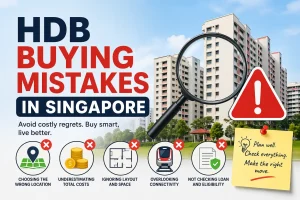
This guide breaks down the 10 most common and costly HDB buying mistakes, explains the real-world consequences, and gives you actionable steps to avoid each one. This is the checklist you need before you commit.
Table of Contents
1. Not Understanding Your True Budget
2. Choosing Location Based on Price Alone
3. Underestimating Hidden Costs
4. Not Fully Understanding BTO vs Resale
5. Overstretching Your Finances
6. Not Thinking Long-Term
7. Rushing the Purchase
8. Not Comparing Loan Options
9. Letting Emotions Take Over
10. Not Doing Enough Research
Frequently Asked Questions (FAQs)
1. Not Understanding Your True Budget
One of the most dangerous traps first-time HDB buyers fall into is confusing loan eligibility with true affordability, one of the most frequent HDB buying mistakes.
Just because HDB or a bank approves you for your maximum loan quantum does not mean borrowing the full amount is a wise decision for your household.
Most buyers only consider their maximum loan amount and available CPF balance. What they overlook is equally important: monthly cash flow after repayments, everyday lifestyle expenses, upcoming financial commitments like starting a family or car ownership, and the critical need to maintain emergency savings.
Why this is dangerous: If you stretch your budget to its limit, even a temporary income disruption, a job change, medical expense, or economic slowdown, can tip your finances into distress. HDB repossessions are rare, but years of financial stress are not.
The smarter approach:
- Target monthly repayments that leave you breathing room, not just survival
- Keep at least 6-9 months of emergency savings untouched
- If a loan feels “just manageable,” it is on the high side
2. Choosing Location Based on Price Alone
A cheaper flat in a far-flung estate is tempting when budgets are tight. But buyers who optimise purely for purchase price often fall into HDB buying mistakes that affect lifestyle and value.
Common problems with poorly located HDB flats:
- Long MRT or bus commutes eating into daily productivity and wellbeing
- Limited food options, supermarkets, or healthcare nearby
- Lower demand from future buyers when you sell
- Slower price appreciation compared to well-connected towns
What to prioritise instead:
- MRT proximity: Flats within 500m–1km of an MRT station consistently command stronger resale premiums
- Amenities: Proximity to hawker centres, supermarkets, clinics, and parks directly affects daily quality of life
- Schools: Critical if you plan to start or grow a family within the next 5–10 years
- Future developments: Check for upcoming MRT, commercial hubs, or parks near your shortlisted area
Location is not a short-term trade-off, it is a long-term investment in both your lifestyle and your property’s future value, and avoiding this HDB buying mistakes here is critical.
3. Underestimating Hidden Costs
The purchase price on your HDB Option to Purchase is just the beginning. Many buyers are blindsided by the full stack of costs that arrive alongside and immediately after their purchase.
Hidden costs that catch buyers off guard:
Buyer’s Stamp Duty (BSD), Legal / Conveyancing fees, Valuation fee (resale), HDB admin fees, Renovation, Furniture and appliances, Moving costs
Estimated total hidden costs can easily add $20,000 to $80,000 or more on top of your purchase price, yet most buyers budget only for the flat itself leading to major HDB buying mistakes.
What smart buyers do:
- Calculate total acquisition cost, not just flat price
- Set aside a dedicated renovation buffer (and then add 20% to that estimate)
- Account for furniture before signing
4. Not Fully Understanding BTO vs Resale
The BTO vs resale decision is one of the most consequential you will make, yet many buyers choose based on a single factor like price or waiting time, without considering the full picture.
Before making a decision, it helps to understand the official definitions, eligibility rules, and application process directly from the HDB website, as these form the baseline for any HDB purchase.
BTO flats:
- Priced below market with government subsidies
- Waiting time of 3–5+ years from ballot to key collection
- Brand new unit with full lease remaining
- Limited to new towns or less central locations (mostly)
Resale HDB flats:
- Immediate or near-immediate move-in
- Greater location flexibility, including mature estates
- Eligible for CPF Housing Grant for eligible buyers
- Higher absolute price but potentially faster to occupy
Questions to ask yourself before deciding:
- Do I have an urgent housing need (e.g., getting married, current lease expiring)?
- Am I willing to wait 4–5 years for a BTO key?
- Is being in a specific location (e.g., near parents) a hard requirement?
- Can I afford the higher upfront cost of a well-located resale flat?
The wrong choice here does not just affect your finances, it affects your daily life for potentially a decade or more. Learn more in our BTO vs Resale HDB guide.
5. Overstretching Your Finances
This is the single most consequential HDB buying mistake on this list and the one with the longest tail of consequences.
Many buyers max out their HDB or bank loan, drain most of their CPF OA, and leave themselves with minimal cash savings, a classic case of HDB buying mistakes. This might work in calm economic conditions. But life rarely stays calm.
Real risks of financial overstretch:
- Interest rate increases on bank loans raising monthly repayments
- Job loss or income reduction with no buffer to absorb the shock
- Inability to fund children’s education, parents’ medical needs, or your own retirement
- Being forced to sell at a bad time if cash flow becomes unsustainable
A safer financial framework:
- Borrow below your maximum eligible loan
- Keep liquid emergency savings post-purchase
- Using all your CPF OA for housing reduces your retirement nest egg. Consider keeping some OA untouched or transferring OA to SA for higher interest.
- Model your repayments at an interest rate 1–2% higher than today’s rate
Financial comfort in your home is worth more than living under constant financial pressure.
6. Not Thinking Long-Term
A flat that is perfect for your life today may be completely unsuitable in five years. Yet most buyers make their decision based entirely on their current situation.
Life changes that affect your housing needs:
- Marriage and having children (space requirements increase significantly)
- Ageing parents who may need to move in with you
- Career changes affecting your preferred location or commute
- Lifestyle shifts, wanting a home office, larger kitchen, or extra room
Buying a flat that does not accommodate your next phase of life typically leads to early upgrading, which carries its own significant costs: agent fees, stamp duties, moving expenses, and renovation all over again.
The better approach: think ahead to avoid repeating this HDB buying mistakes when upgrading later.
7. Rushing the Purchase
What rushing typically causes:
- Overpaying because you did not compare enough comparable units
- Settling for a poor layout, undesirable flat attributes, or noisy location
Rushing typically causes poor decisions and is one of the easiest HDB buying mistakes to avoid.
How to protect yourself:
- Set your criteria before viewing and and stick to them
- View at least 5–10 units before making any offer
- Build in a cooling-off period in your own decision-making, even if not legally required
- Never let external pressure override your financial logic
8. Not Comparing Loan Options
Many buyers simply take the first loan offered, usually the HDB Concessionary Loan without understanding whether it is truly the best option for their situation.
An HDB housing loan offers a concessionary interest rate, currently fixed at 2.6% per annum. This fixed rate provides stability and predictability for your monthly repayments, protecting you from fluctuations in interest rates.
Bank housing loans offer floating interest rates pegged to a benchmark, or fixed interest rates for a pre-determined time period, usually one to three years, before reverting to floating. If you prefer predictability and stability, an HDB housing loan with its fixed interest rate might be more suited for you. However, if you have a higher-risk appetite and are willing to bet on the possibility of lower interest rates in the future, a bank housing loan can be the option.
HDB loans offer more flexibility, you can refinance to a bank loan later, but not the other way around.
What to do:
- Compare at least 2–3 bank loan packages before deciding
- Understand lock-in periods and penalty clauses
- Consult a mortgage broker if you are uncertain
9. Letting Emotions Take Over
Buying a home is inherently emotional. But emotional decision-making is a major driver of HDB buying mistakes. One of the largest purchases of your life can be extremely costly.
Common emotional traps:
- Falling in love with a unit’s renovation and paying above market for it
- Feeling panicked about “missing out” and waiving legitimate concerns
- Anchoring to a specific estate because of sentimental attachment, even when alternatives are objectively better
What disciplined buyers do:
- Treat every viewing as a data-gathering exercise, not an emotional experience
- Have a trusted friend or advisor accompany you to provide a second, objective perspective
- Always run the numbers before any offer, ie does the price make rational sense?
- Remember: you can always renovate, but you cannot move the location
A home should make financial sense first, and emotional sense second. Emotional decision-making is a major driver of HDB buying mistakes.
10. Not Doing Enough Research
Knowledge is your single greatest advantage in the HDB buying process. Yet many buyers begin their search before they understand even the basics of eligibility, grants, financing, or the purchase process.
What you must understand before you start:
- Your HDB eligibility (citizenship, income ceiling, ethnic quota, prior property ownership)
- Available grants (Enhanced CPF Housing Grant, Proximity Housing Grant, etc.)
- The full buying timeline and key milestones
- How valuation, negotiation, and the Option to Purchase process works
- Your CPF withdrawal limits and the impact of Accrued Interest
Minimum research before making any offer:
- Read the official HDB website thoroughly
- Understand the current resale price trends in your target estate
- Speak to at least one property agent and one independent financial advisor
- Study recent comparable transactions on HDB’s resale flat prices portal
Don’t Forget Resale Value – A Common Oversight
Even if you plan to live in your flat forever, your circumstances may change. Job relocation, family needs, or financial pressure can force a sale at any time — and you want to be selling an asset, not a liability.
Factors that drive strong HDB resale value:
- MRT proximity (within 1km is ideal)
- High floor with good views and natural light
- Regular or premium layout with minimal wasted space
- Upcoming infrastructure or commercial developments nearby
Factors that suppress resale value:
- Units facing a wall or carpark
- Odd or inefficient layout
- Proximity to noisy road or busy expressways
- Remaining lease (affects CPF usage for future buyers)
Always buy something that other buyers will want in the future and not just something you want today.
Read our complete HDB Buying Guide: 8 Things Every Buyer Must Know
HDB Buying Mistakes Frequently Asked Questions (FAQs)
1. What are the most common HDB buying mistakes in Singapore?
The most common mistakes include overestimating affordability, ignoring hidden costs, choosing poor locations, and failing to plan long-term. Many buyers also rush decisions or rely too heavily on emotions instead of data.
2. Is it better to buy a BTO or a resale flat?
It depends on your situation. BTO flats are cheaper but require a long waiting time, while resale flats offer immediate move-in and may be in better locations. Your timeline, budget, and lifestyle needs should guide your decision.
3. What hidden costs should I budget for when buying an HDB?
Besides the flat price, you need to account for Buyer’s Stamp Duty, legal fees, valuation fees (for resale), renovation, furniture, and moving costs.
4. Should I take an HDB loan or a bank loan?
HDB loans offer stability with fixed interest rates, while bank loans may offer attractive packages but come with more risk. It’s important to compare multiple options and understand lock-in periods before deciding.
5. How can I avoid overpaying for a resale flat?
Study recent comparable transactions in the area, view multiple units, and avoid rushing into offers. Always base your decision on data rather than emotions or fear of missing out.
6. How does resale value affect my HDB purchase?
Even if you plan to stay long-term, resale value matters. Factors like location, layout, floor level, and remaining lease will influence how attractive your flat is to future buyers.